
How much food do you need for a birthday party?
Plan birthday-party food with per-person quantity estimates, simple menu combinations and serving formats that fit your space and guests.
By Celebration Help
For a birthday party, first decide whether the food is a snack between meals, a meal made of finger foods, or a full lunch or dinner. That choice matters more than the number of dishes. A few trays of small bites can suit an afternoon gathering but leave guests hungry at dinner time.
Then build one complete menu, calculate portions across it, and choose a serving format you can manage. The quantities below are starting estimates—not guarantees of appetite.
How much food to plan per person
Count everyone who will eat, including hosts, helpers and parents staying at a children’s party. Note dietary requirements separately so an alternative meal is included in the total rather than treated as an extra garnish.
Nicolet College’s catering guide bases quantities on guest count, age, event length, time of day and service format. It suggests a 5–10% allowance for unexpected guests or larger appetites. Use that as a modest buffer, not a reason to double every tray.
| What you are serving | Starting estimate per person |
|---|---|
| Small appetizers before a full meal | 4–6 pieces for a casual gathering |
| Finger foods at a light, appetizer-only event | 8–12 pieces |
| Finger foods replacing dinner | 12–15 pieces |
| Meat-and-sides meal | 6–8 oz of the main protein food in total, plus ½ cup of a starch and ½ cup of vegetables |
| Bread alongside a meal | 1–1½ rolls or pieces |
| Birthday cake as the dessert | 1 serving |
The casual pre-meal estimate comes from Messina’s Catering’s planning guidelines; the other estimates come from Nicolet College. These are catering rules of thumb, not nutritional serving recommendations.
Do not add all the rows together. Choose the rows that describe your menu. If finger foods replace dinner, you do not also need a full meat-and-sides meal.
A “piece” is only useful when the bites are comparable. A small pastry bite and a substantial slider are not equivalent. For larger foods such as sandwiches or pizza, use the supplier’s portion size or the recipe’s yield, then adjust for your guests. For children, ask caregivers about likely portions rather than applying one reduction to every age; teenagers may need adult portions or more.
Worked example: a buffet for 20 meal-eating guests
Using a 10% buffer gives 22 planned portions. For a simple meat-and-sides menu, the estimates above translate to:
- Main protein foods: 132–176 oz, or 8¼–11 lb, across the choices—not that amount of each choice.
- Starch: 11 cups.
- Vegetables: 11 cups.
- Bread: 22–33 rolls or pieces.
- Cake: at least 22 servings at the slice size you intend to serve.
These are portion totals, not a raw-ingredient shopping list. Bones, trimming and cooking losses affect purchase quantities; use your recipe’s yield or ask the caterer or butcher how much to buy for the required portions.
If some guests need a separate main, reserve their portions first and reduce the other main accordingly. Do not divide two mains equally unless you expect equal demand.
Build a menu that works as a whole
A useful default is one filling main, one substantial dietary alternative where needed, two supporting foods and birthday cake. More choices can mean more shopping, utensils and leftovers without making the meal more complete.
These are suggested combinations, not fixed menus:
| Party food brief | A manageable menu | Main planning check |
|---|---|---|
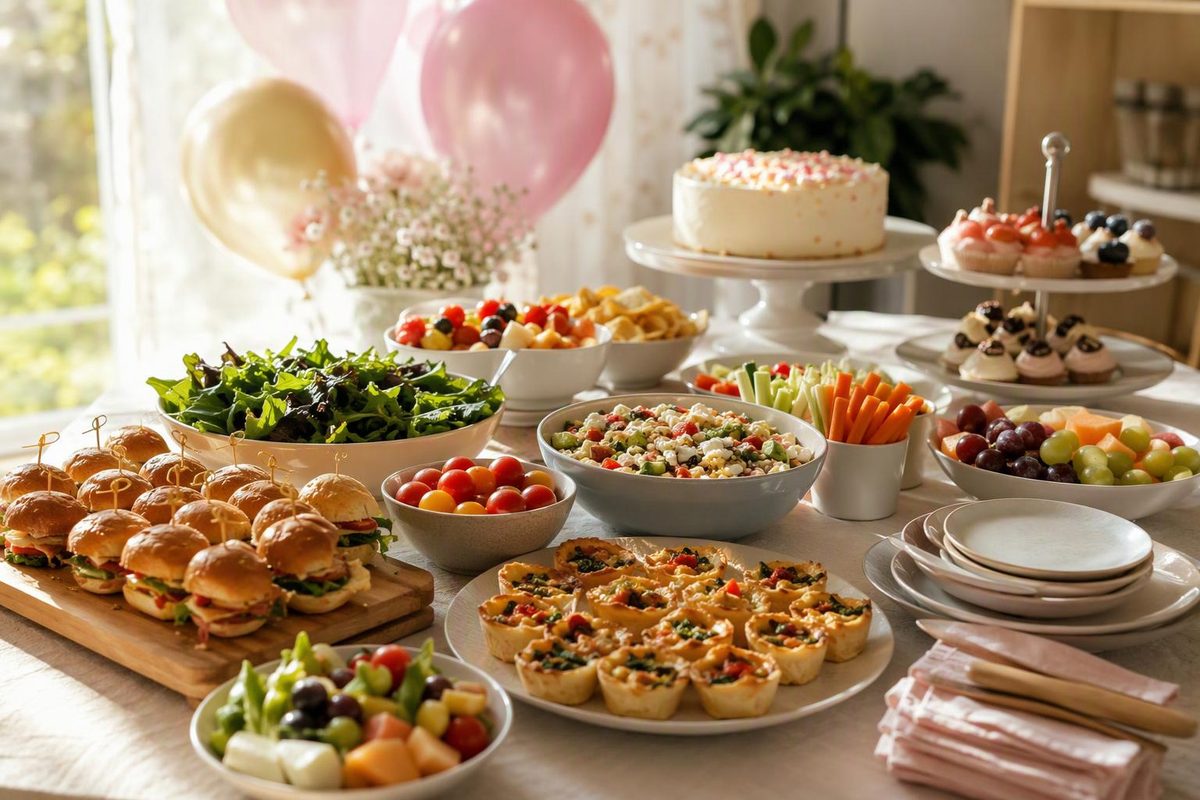
| Between-meal afternoon party | Sandwich bites, vegetables with dip, fruit and cake | Tell guests it is light refreshments, not lunch |
| Lunch or dinner buffet | A meat main and a bean-based alternative, rice or potatoes, vegetables and cake | Make sure the alternative forms a full meal with the sides |
| Standing finger-food meal | Sliders or substantial wraps, savory pastries, vegetables with dip and cake | Include filling foods, not just crisps and sweets |
Choose dishes that share preparation methods without competing for the same equipment. Three foods that all need the oven immediately before serving create a bottleneck. A practical mix might be one hot main, sides prepared ahead and a ready-to-serve dessert.
Let the birthday person’s favorite food anchor the menu, then simplify around it. If cake is the main sweet moment, a second full dessert course is optional.
For the wider decisions that determine the food budget and guest count, see the birthday-planning order that prevents rework.
Choose the serving format before buying trays
| Format | Useful when | What to arrange |
|---|---|---|
| Buffet | Guests want choice and you have room for a queue | Serving utensils, clear dish labels, space for plates and someone to replenish food |
| Pre-portioned plates or boxes | You want predictable portions or need to hand out meals quickly | Confirmed meal choices and clearly identified special meals |
| Family-style bowls at tables | Guests are seated in small groups | Enough table space and serving utensils for every table |
| Finger-food stations or passed trays | Guests will mingle rather than sit for a meal | Foods manageable without a knife; offer seating for anyone who needs it |
These are practical trade-offs rather than rules. A buffet does not eliminate host work: someone still needs to check temperatures, change platters and clear used dishes. Put drinks away from the food queue if space allows, and serve cake separately so it does not compete with the main meal.
Agree allergy arrangements before finalizing the menu
Ask guests—or a child’s caregiver—what they need to avoid and what preparation arrangements they require. Keep packaging and ingredient information available for bought foods, including cake, sauces and dips.
Food Allergy Research & Education explains that even small amounts of allergen transferred through food or utensils can cause reactions, and cooking does not remove that risk. Wash preparation equipment and utensils thoroughly with hot, soapy water, and use separate serving utensils. Wash hands with soap and water after handling an allergen; keep an agreed special meal covered and apart from shared dishes.
Labels alone do not prevent cross-contact. If you cannot verify ingredients or manage preparation and serving as required, say so before the party and agree another arrangement with the guest or caregiver. Do not describe a dish as allergy-safe based only on its recipe.
Serve in batches and keep track of time
For a home party, the U.S. FDA’s buffet guidance recommends small serving dishes, with cold backups refrigerated and fresh dishes brought out as needed. Replace nearly empty platters rather than topping them up.
The FDA and USDA advise:
- Keep cold food at 40°F / about 4°C or below and hot food at 140°F / 60°C or above. Check with a thermometer; a warming tray is not automatically hot enough. These are holding temperatures, not cooking or reheating instructions.
- Discard perishables left at room temperature for more than two hours, or one hour when the surrounding temperature is above 90°F / about 32°C, unless safely held hot or cold.
- Refrigerate food you intend to keep promptly. Do not save food that has exceeded the safe time limit.
Count time during transport and setup too, not just time after guests arrive. If you cannot maintain safe temperatures, change the menu, shorten the serving window or arrange suitable equipment. For a catered event or venue service, confirm the operator’s arrangements and applicable local requirements rather than treating U.S. home-party guidance as the governing rules.