
Christmas dinner menus, dietary checks and a workable cooking schedule
Choose a Christmas dinner menu with practical combinations, dietary coordination, backwards timing and source-linked food-safety guidance.
By Celebration Help
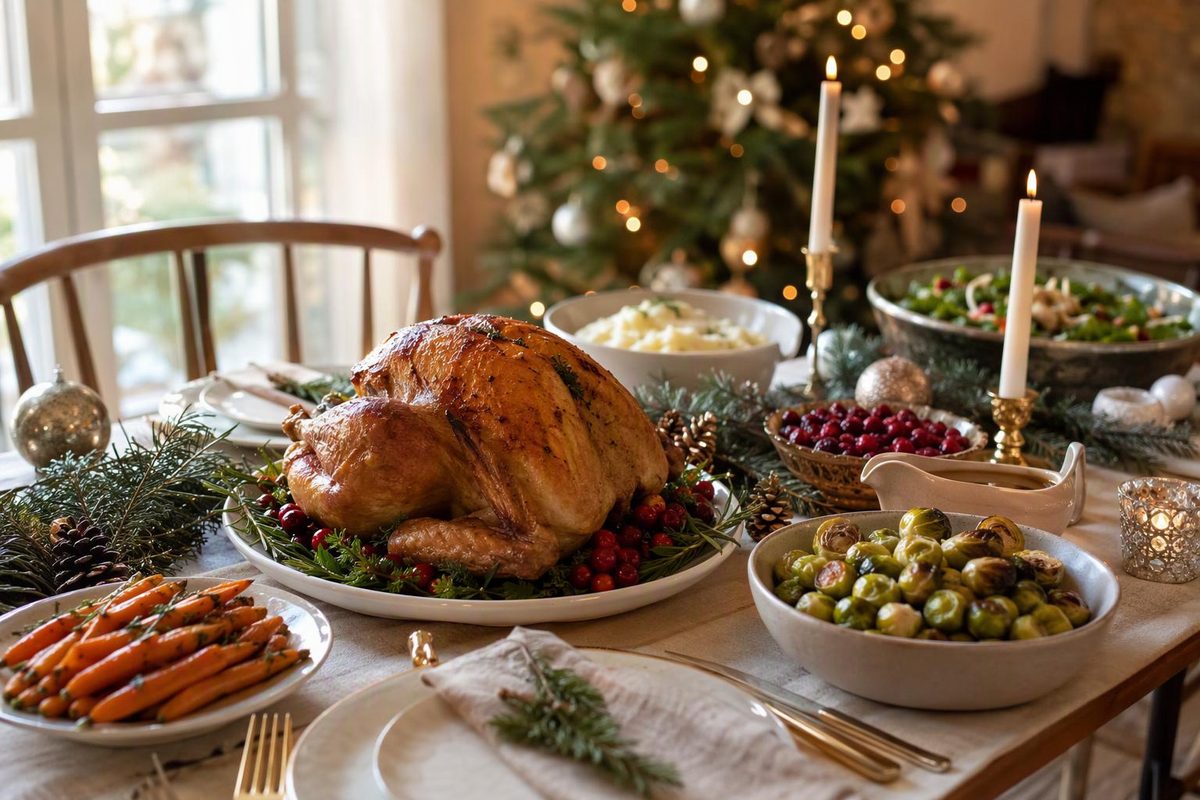
For a manageable Christmas dinner, start with one main, one potato dish, two vegetables, gravy or another sauce, and one dessert. Add stuffing or a starter only if it matters to your guests and fits the cooking schedule.
The combinations below are planning suggestions, not fixed traditions. Choose the menu around who is coming, then check that its dishes can actually share your kitchen.
Three Christmas dinner menus
| Menu | Main and accompaniments | Dessert | Kitchen trade-off |
|---|---|---|---|
| Classic turkey | Roast turkey; roast potatoes; carrots; Brussels sprouts; gravy and cranberry sauce. Optional stuffing baked separately. | A bought Christmas pudding, prepared according to its instructions, or a make-ahead dessert | Turkey, potatoes and stuffing compete for oven space. Choose mashed potatoes instead if the roasting schedule does not fit. |
| Smaller gathering | Roast chicken or turkey breast; mashed potatoes; stovetop carrots and green beans; gravy and cranberry sauce | A make-ahead chocolate mousse or bought cake | The main uses the oven while the sides use the hob. Include any chilling time in the dessert plan. |
| Plant-based centrepiece | Lentil-and-mushroom pie made with plant-based pastry; roast potatoes in vegetable oil; carrots; Brussels sprouts; vegetable-stock gravy | Apple crumble made with dairy-free ingredients | Pie, potatoes and crumble all need the oven. Bake the crumble ahead using a recipe that permits it, or choose a dessert that needs no oven time. |
For a mixed table, you can serve turkey alongside the lentil-and-mushroom pie, with shared plant-based sides. Treat the pie as a proper main: choose a recipe whose yield covers the guests eating it, plus anyone else likely to want a portion.
A starter is optional. If you want one, choose something that does not need last-minute cooking. A separate hot starter adds another serving deadline before the main meal.
Settle dietary needs before buying ingredients
Ask each guest what they need to avoid, whether it is an allergy, coeliac disease, another medical requirement, a religious restriction or a preference. Then agree on a main, suitable sides and a dessert—not just one dish they can eat.
Check the details of the chosen recipes:
- Vegetarian or vegan: use suitable stock, cooking fat and pastry; keep meat gravy separate.
- Gluten-free: check stuffing, pastry, gravy thickeners, stock and dessert ingredients rather than assuming a roast meal is gluten-free.
- Milk-free: check butter, cream, pastry, chocolate and bought sauces.
- Food allergies: confirm the exact ingredients and the preparation arrangements with the guest. As the UK Food Standards Agency explains, a vegan label is not an allergen-free guarantee.
Keep packaging so guests can inspect it. The FDA advises reading the full ingredient information every time you buy a product, because ingredients can change. In the US, “may contain” warnings are voluntary; their absence is not proof that cross-contact is impossible.
For allergy-related preparation, thoroughly clean work surfaces and equipment, and wash hands with soap and water. Use pans and utensils washed with soap and water, prepare the suitable meal first, and keep it covered and away from other cooking. Give each dish its own serving utensil. FARE’s cross-contact guidance explains these precautions. The Food Standards Agency’s home-cooking advice also stresses thorough cleaning and warns that kitchen heating does not remove allergenic risk.
If you cannot verify an ingredient or reliably manage the agreed preparation arrangements, do not promise that the meal is safe. Agree on an alternative with the guest before Christmas Day.
Build the timing plan backwards
Set the main-course serving time first. Then list each dish’s preparation time, cooking time, oven temperature, pan space and any resting or chilling time from its recipe or packaging.
For a 2pm main course, work backwards in this order:
- Carving and serving: reserve time immediately before 2pm, and assign someone else to bring out vegetables and sauces.
- The main’s rest: subtract the resting time specified by its recipe to find its target oven-out time.
- Cooking: subtract the main’s estimated cooking time, with some scheduling margin. A timetable is not a substitute for checking doneness.
- Side dishes: give each one a start time based on its recipe. Confirm that any oven dishes fit both the available space and temperature.
- Preparation and preheating: put these before cooking, rather than treating them as part of the roasting time.
Do not assume the turkey’s resting period is long enough to cook roast potatoes or stuffing from scratch. If those dishes need longer, plan another compatible oven slot, use another suitable appliance, or change the menu.
The following food-safety figures use US government guidance. FoodSafety.gov’s roasting and thawing charts estimate 3–3¾ hours at 325°F (163°C) for an unstuffed 12–14 lb turkey. Turkey must reach 165°F (74°C), checked with a food thermometer in the thickest part of the breast and the innermost parts of the thigh and wing. Use the temperature—not the estimated finish time—to decide whether it is ready.
What to do ahead, and what to leave for the day
| When | Christmas dinner tasks |
|---|---|
| Before the final shop | Confirm dietary arrangements; choose recipes and quantities from their yields; check oven capacity, fridge space and serving dishes. |
| Several days ahead, if using frozen turkey | Schedule refrigerator thawing. Allow about 24 hours per 4–5 lb in a fridge at 40°F (4°C) or below, following the government thawing chart. |
| Christmas Eve | Make desserts and sauces only where the recipe permits advance preparation; follow their storage instructions. Label dishes, set out serving utensils and write down the next day’s cooking order. |
| Christmas morning | Complete remaining preparation; keep chilled food refrigerated until needed; start the main according to the backwards plan. |
| Before serving | Check the main’s temperature, finish vegetables and gravy, carve, and bring out the agreed dietary portions with their own utensils. |
If the main is running late, move the serving time rather than serving undercooked food. Keep finished hot dishes safely hot instead of leaving them on the counter.
Include clearing away in the plan
Have shallow storage containers ready before dinner. Under USDA leftovers guidance, keep hot food at 140°F (60°C) or above and cold food at 40°F (4°C) or below. Refrigerate perishable leftovers within two hours of cooking or removal from hot holding—one hour if the surroundings exceed 90°F (32°C).
Divide large quantities into shallow containers and cut turkey into smaller portions for rapid cooling; do not wait for a whole bird to cool on the counter. Properly refrigerated leftovers can be kept for 3–4 days, or frozen. Reheat leftovers to 165°F (74°C). Discard perishable food that has exceeded the room-temperature limit rather than saving it for Boxing Day.